
Income Statement
Wondering what does income statement mean in accounting? It is the report that shows whether a business made or lost money over a set period, built by starting with sales and subtracting every cost.
What is an Income Statement?
An income statement is a financial statement that lists revenue, expenses, gains and losses for one reporting period and ends with net income or a net loss. It is also called a profit and loss statement (P&L), statement of earnings or statement of operations. The period, whether a month, a quarter or a year, appears in the heading. Lenders, investors and owners read it to judge profitability, and listed companies must file it with the SEC.
Income Statement Structure
The structure of an income statement runs from top to bottom, with each subtotal feeding the next line:
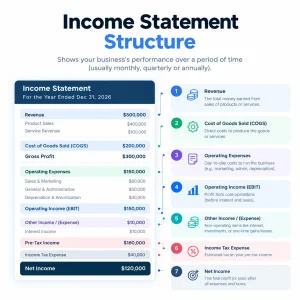
- Revenue at the top
- Minus COGS, which leaves gross profit
- Minus operating expenses, which leaves operating income
- Minus interest and other non operating items, which leaves pre tax income
- Minus income taxes, which leaves net income
Small businesses often use a single step income statement, which subtracts total expenses from total revenue in one calculation. Larger companies use a multi step income statement that shows the subtotals above.
Net Income Formula
Income Statement Example Overview
Among the examples of income statements in accounting, a small bike repair shop shows the mechanics clearly.
Here is one month of figures:
| Line | Amount |
|---|---|
| Revenue (repairs $18,000, parts sales $6,000) | $24,000 |
| COGS (parts and supplies) | $8,400 |
| Gross profit | $15,600 |
| Operating expenses (rent, wages, utilities, insurance, marketing) | $10,900 |
| Operating income | $4,700 |
| Interest expense | $350 |
| Income taxes | $900 |
| Net income | $3,450 |
The shop’s net profit margin is 3,450 divided by 24,000, about 14.4%. It keeps roughly 14 cents of each dollar it takes in.
Different Parts of an Income Statement
An income statement breaks down how a business moves from revenue to its final profit.
The key components of income statement include:
Money earned from selling goods or services, often called the top line. Interest, rent, and royalties may also be reported as non-operating revenue.
The direct costs associated with goods or services sold, such as materials and delivery labor.
The amount remaining after subtracting COGS from revenue.
Gross Profit = Revenue − COGS
The costs of running the business, including rent, wages, insurance, marketing, and SG&A, along with depreciation and amortization.
Profit generated from regular business operations before interest and taxes. EBITDA goes further by adding back depreciation and amortization.
One-time or non-routine items, such as a gain from selling an old vehicle or a loss from settling a lawsuit.
The income remaining after interest expense and other non-operating items, before income taxes.
The bottom line remaining after income taxes. Public companies also report earnings per share (EPS) below net income.
Download Free Income Statement Template
A free income statement template saves rebuilding the layout every period. A useful income statement template carries the lines described above, with revenue on top, formulas that calculate each subtotal, and one column per month, quarter or year so year over year changes are easy to see. Enter revenue and expenses, and the template works out gross profit, operating income and net income on its own.
Ready to Prepare Your Income Statement?
Download our free income statement template to organize your revenue, expenses, gains, losses, and net income in one place.
Income Statement vs Balance Sheet vs Cash Flow Statement
- Income statement: performance over a period, answering whether the business made money.
- Balance sheet: assets, liabilities and owner’s equity on a single date.
- Cash flow statement: cash actually moving in and out over a period.
Revenue is recorded when it is earned, not when the customer pays, so a business can post a profit and still run short of cash. That is why the three statements are read together.
The Bottom Line
The income statement ends at net income, and every line above it explains how the business got there. Check the reporting period in the heading, then compare the same lines across several periods before judging a single result.